
Power Quality & Generation
Balance of Generation and Load
Self-Regulation Mechanism
In AC power systems, electrical generation must always match the electrical load plus losses due to minimal electrical storage capability. This real-time balancing act is vital for maintaining system stability. To some extent, the electrical system is self-regulating. The voltage and the frequency drop if generation is less than load, and thereby the load goes down to equal the generation minus the transmission losses. However, there are a few percent margins for such a self-regulation. If voltage is propped up with reactive power support, then the load will go up and consequently the frequency will keep dropping and the system will collapse.
Voltage and Frequency Dynamics
Voltage Drops: If the electrical generation is less than the load, the voltage tends to drop. Voltage drop affects the power delivered to loads, especially those sensitive to voltage changes like motors and electronic devices.
Frequency Drops: When generation is less than the load, the frequency of the system drops. Many electrical loads, especially motors, are frequency dependent. A drop in frequency reduces their speed and power consumption, partially self-regulating the load.
Reactive Power
Voltage can be controlled using reactive power (VArs). Reactive power does not transfer energy but helps in maintaining voltage levels within the desired range. Capacitors and inductors are commonly used for reactive power compensation.
Capacitors provide leading reactive power (positive VArs) to support voltage levels, while reactors provide lagging reactive power (negative VArs) to reduce voltage levels.
Risks of Over-Voltage Support and Frequency Collapse
While reactive power support can maintain voltage levels, it can inadvertently increase the real power demand. This is because higher voltage levels can increase the power drawn by loads, especially those that are voltage dependent. If the generation cannot keep up with the increased demand, the frequency will continue to drop. Persistent frequency drops can lead to under-frequency load shedding or, in extreme cases, a system blackout.
Load Shedding
In severe imbalances, automatic load shedding schemes disconnect non-essential loads to prevent system collapse. This helps to quickly balance generation and load, stabilizing frequency and voltage.
Contribution of Capacitive Loads on Generator Voltage Instability
A purely capacitive load can cause the generator control system (AVR) to lose control. The consequence will be voltage instability and possible high voltage at the generator outputs. Capacitive loads can significantly destabilize generator voltage, particularly through their interactions with the Automatic Voltage Regulator (AVR). This instability arises due to the leading power factor (PF) characteristic of capacitive loads, which complicates the AVR’s voltage regulation efforts. Understanding the mechanisms at play can help in mitigating these issues, especially during critical phases such as the start-up of stand-by generators.
Normal Operation with Lagging or Unity PF
In typical operations, loads have a lagging or unity power factor (PF=1). The AVR adjusts the excitation current to maintain the generator’s terminal voltage. A lagging PF indicates that the current lags behind the voltage, which is common in inductive loads.
Effect of Leading PF (Capacitive Loads)
For capacitive loads, the current leads the voltage. This leading PF can cause the AVR to misinterpret the system’s needs. When the load current increases in a capacitive load scenario, the AVR might incorrectly reduce the excitation voltage, thinking there is an over-voltage condition. This reduction in excitation leads to further increases in terminal voltage.
As the AVR decreases excitation to counteract what it perceives as over-voltage, the generator’s voltage actually increases due to the leading PF load.
This situation can create a feedback loop where the AVR continuously reduces excitation, leading to a runaway increase in terminal voltage until the AVR loses control completely, resulting in significant voltage instability and potentially damaging the generator and connected equipment.
Impact on Stand-by Generator Start-Up
Capacitive loads can create issues for stand-by generator start up. When the main electricity supply fails, inductive loads like motors are disconnected. This disconnection is crucial because these loads typically provide a stabilizing lagging PF.
On start-up, the generator may encounter a load predominantly consisting of lighting and power factor correction capacitors. Many lighting systems, such as certain types of fluorescent lighting, exhibit a leading power factor.
In this condition, the AC generator would see a leading power factor and would become unstable and generates high voltage at outputs.
It is advisable to ensure that power factor correction capacitors are not connected during the initial loading of the generator. This action prevents the AVR from misinterpreting the leading PF load and losing control.
Gradually connecting loads can help stabilize the generator before introducing significant capacitive loads. This staged approach allows the AVR to adjust properly to changing load conditions without being overwhelmed by a sudden leading PF load.
Impact of Generator Reserve Reactive Power on Voltage and Frequency Stability During Large Motor Start-Up Scenarios
It is essential to ensure that the generator has adequate spinning reserve capacity, both in terms of reactive and active power, to maintain voltage and frequency stability during large motor start-up scenarios. Properly tuned governor and AVR settings, along with a thorough system power study, are necessary to verify that the power system design complies with standard AS60038. Ensuring these parameters will help mitigate the risks associated with voltage drops, frequency drops, and prolonged recovery times, thereby enhancing the overall stability and reliability of the power system during such transitional conditions.
Large motor start-up introduces a transition condition to the power system. The impact of generator reserve reactive power on voltage and frequency stability during large motor start-up scenarios is essential in ensuring system reliability and compliance with AS60038, which defines voltage and frequency deviation limits under transient conditions. System power study must be delivered to verify the system design and to ensure compliance with AS60038.
Voltage and frequency variations and system recovery time depend on the availability of the generator spinning reserve, dynamics of the governor, dynamics of the AVR, size of the motor, and size of the general electrical loads connected to the plant.
Generator Spinning Reserve
Definition: Spinning reserve refers to the additional generating capacity that a generator can immediately supply by increasing its output.
Voltage and Frequency Stability
When a typical induction motor becomes energized, a current higher than the motor’s normal operating current rushes into the motor. The inrush current is required to establish the magnetic field in the rotor, which allows it to overcome its initial inertia and any load torque. The power factor (PF) of a starting motor (about 0.2) is lower than the power factor of a running motor (about 0.8) due to the high inrush current and low torque production.
Motor start-up high current rushes through the system, causing a voltage drop across the entire system. The system’s self-regulation concept ensures that load demand matches generation capacity. However, during transient conditions like motor start-up, the system may experience a temporary imbalance, causing frequency and voltage fluctuations. The time it takes for the system to recover to stable operation depends on the size of the motor, the generator’s reserve capacity, and the dynamic response of both the governor and AVR.
The power generation unit must be capable of supplying the required reactive and active power to maintain the motor start-up torque. If the generator has sufficient reserve capacity, it can more effectively handle the sudden demand for both active and reactive power.
Starting a large motor introduces a large load to the power supply system. The AVR (Automatic Voltage Regulator) reacts to the need for reactive power impacted by a sudden change in the power factor (PF) of the connected load. Therefore, less active power would be available for the entire electrical system. The system puts the generator engine under pressure. Engine speed suddenly falls and causes a frequency drop. The governor takes reaction and helps the engine recover by injecting more fuel/gas into the engine.
Parallel Operation of AC Generators
In parallel operation of AC generators, careful management of active and reactive power sharing, control of circulating currents, and proper system protection (such as reverse power relays) are critical for reliable and efficient operation. Understanding the electrical characteristics and interaction between different generators is essential to avoid system instability, equipment damage, and potential failures.
Control of kW (Active Power) and kVAR (Reactive Power) Components
The active power (kW) generated by an AC generator is controlled purely by mechanical means. This involves adjusting the speed of the prime mover (engine) driving the generator. Fine control of the engine speed is essential because the output frequency of the generator must match the grid or bus-bar system frequency. A limited-range governor helps maintain the engine speed within a desired range, avoiding large fluctuations.
The reactive power (kVAR) is controlled by adjusting the excitation of the AC generator. Excitation refers to the DC current supplied to the rotor windings of the generator, which creates a magnetic field. The level of excitation determines the internal voltage of the generator, and hence, its reactive power output.
Paralleling AC Generators
When machines are operating in parallel, depending on the relative size of the generator to the bus-bar system, the magnitude of the field excitation will not directly influence the output voltage. It does, however, adjust the internal power factor at which a particular machine operates. For instance, an over-excited AC generator will produce a lagging PF current from that generator.
When differences exist in excitation, circulating current will follow, limited only by the internal machine reactance. This circulating current appears as a zero PF loading or lagging current and, depending on the machine excitation, would either subtract or add to the total current that each machine supplies. Reactive current, either loading or lagging, is by virtue of a 90º phase displacement, quite commonly described as being quadrature. The generator must therefore be provided with equipment to sense this reactive current and limit it to an acceptable level (the quadrature droop current transformer).
Quadrature Droop Current Transformer
This equipment is used to sense and limit the reactive circulating current between generators. It helps maintain balanced reactive power sharing between generators by monitoring the quadrature (90º phase displacement) reactive current. Proper adjustment ensures that reactive current sharing remains within acceptable levels.
Load Sharing and Stability
As a guide for the load sharing for similar generators, the DC excitation volts should be approximately equal when the generators are correctly sharing reactive and active current.
Reverse Power Relay Protection
A Reverse power relay is critical for protecting generator sets in the event of a shutdown due to faults such as low oil pressure or temperature. If a generator set fails and is not isolated, other operating generators will attempt to “motorize” the failed set. This means the working generators will feed power back into the failed generator, causing it to act as a motor rather than a generator. This can overload the remaining generators and cause damage to the prime mover (engine) of the motorized set.
Paralleling System Neutrals
It should be noted that paralleling of all system neutrals can under certain circumstances lead to overheating or possible stator burnouts. This is particularly evident when machines of dissimilar manufacture are paralleled. When paralleling generators from different manufacturers, differences in the waveforms generated by each machine can result in significant harmonic circulating currents through the neutrals. These currents can lead to overheating or potential stator burnouts. The neutral of dissimilar machines must, therefore, never be connected. Neutrals of like machines may be connected.
AC Generator Parallel with the Public Supply
Generator “Droop Operation Mode” versus “Isochronous Operation Mode”
Droop Control: The unit is NOT controlling the frequency of its output; the grid is doing that.
Isochronous: The unit MUST and WILL adjust its fuel to make the frequency of its output equal to the frequency setpoint in response to load changes.
Droop-Controlled Generator and Grid Connection
A droop-controlled generator, when paralleled with the grid, does not control its own frequency. Instead, its output frequency follows the grid frequency. This means that any changes in the grid frequency will directly affect the generator’s output frequency. The droop characteristic allows for automatic sharing of load changes between the generator and the grid without overloading either source.
The grid voltage can vary ±10% as limited by local regulations. A power factor controller is required to be implemented for the droop unit when paralleled with the grid. This enables the generator to maintain a constant power factor and, therefore, maintain control of the resultant reactive currents when the grid voltage is stepped up or down by the authorities.
By implementing a power factor controller, the generator adjusts its excitation to maintain a steady power factor, even when the grid voltage fluctuates. The PFC adjusts the generator’s reactive power output to compensate for voltage variations. If the grid voltage steps up, the generator reduces its reactive power output, and vice versa. This ensures that the generator does not unintentionally absorb or inject excess reactive power into the grid.
Differences between Dynamic and Static Excitation Systems in an AC Generator System
Dynamic and static excitation systems are two types of excitation systems used in synchronous generators to control the magnetic field in the rotor, which is for regulating the output voltage and reactive power of the generator.
The most parts of a dynamic excitation system are connected to the rotor. Therefore, the carbonic brushes can be removed. Dynamic excitation system is sometimes called brushless excitation systems.
In static excitation systems, the static rectifier supplies the excitation current to the field of the synchronous generator through the slip rings.
Dynamic (brushless) excitation systems offer reliability and low maintenance, making them suitable for applications where simple and robust operation is required. On the other hand, static excitation systems provide more precise control and faster response times, which are essential for complex grid-connected generators and systems that require tight regulation of voltage and reactive power. The choice between the two systems depends on the specific application requirements, operational environment, and maintenance capabilities.
Dynamic Excitation Systems (Brushless Excitation Systems)
The excitation system consists of an exciter, which is a small AC generator mounted on the same shaft as the main generator rotor. The exciter generates an AC voltage, which is then rectified by a rotating rectifier assembly mounted on the rotor to produce a DC current. This DC current is fed directly to the rotor winding of the main generator.
Since there are no carbon brushes or slip rings, there is no wear and tear associated with these components. This leads to reduced maintenance requirements and costs. The absence of mechanical contacts reduces the risk of faults, such as brush arcing or brush wear, leading to improved reliability. With fewer components in contact, electrical losses due to friction and resistance are minimized.
Brushless systems have less flexibility in terms of controlling the excitation voltage directly from an external control system. The rotating rectifier assembly requires careful balancing and insulation, which can add to the complexity of the system design.
Static Excitation Systems
In a static excitation system, the excitation current is supplied to the rotor field winding through slip rings and brushes. This system uses a static rectifier, which is a stationary device that converts AC power from an external source (such as an auxiliary generator or the grid) into DC power.
The DC power from the rectifier is then supplied through slip rings and carbon brushes to the rotor winding of the synchronous generator. The static rectifier system is typically installed near the generator, and it does not rotate with the rotor.
Static excitation systems allow for direct control of the excitation voltage and current from an external control system, providing more flexibility in regulating the generator’s output voltage and reactive power, and leading to faster response times in dynamic conditions (e.g., during faults or load changes).
With modern power electronics, static excitation systems can achieve precise control of excitation, making them ideal for complex grid interconnections and stability requirements.
The use of slip rings and carbon brushes requires regular maintenance due to wear and tear, which can increase operational costs. The brushes can cause arcing, which can lead to potential faults or degradation over time. The contact between brushes and slip rings causes electrical resistance and mechanical friction losses.
Key Differences Between Dynamic and Static Excitation Systems
| Feature | Dynamic Excitation (Brushless) | Static Excitation |
|---|---|---|
| Excitation Method | Brushless with rotating rectifiers | Slip rings and brushes with static rectifiers |
| Maintenance Requirements | Low (no brushes or slip rings) | High (brushes and slip rings require maintenance) |
| System Flexibility | Less flexibility in external control | More flexibility and direct control |
| Response Time | Slower response due to mechanical components | Faster response due to electronic control |
| Reliability | High (fewer mechanical components) | Moderate (potential for brush arcing and wear) |
| Electrical Losses | Lower (no brush contact losses) | Higher (brush contact losses) |
| Application Suitability | Ideal for less demanding, reliable setups | Suitable for complex, fast-response scenarios, such as grid interconnections |
Definition of Changeover Times for Generators
The classification of changeover times determines the suitability of a generator system for different applications. Critical applications require “No Break” systems to ensure continuous operation without any interruption, while less critical applications can operate with longer changeover times, such as “Medium Break” or “Long Break” systems. This classification helps in designing appropriate power backup strategies to match the specific needs of different facilities and operations.
Definition: Changeover times for generators refer to the duration it takes for a generator to begin supplying power after a power loss or disconnection of the primary power source. These times determine how seamless the transition is between the loss of mains power and the restoration of power by the generator.
Classification of Generator Changeover Times
No Break
A power supply system that ensures a continuous supply without interruption during the transition period from the primary power source to the generator. There are no noticeable breaks in power supply, and the system can maintain specified conditions for voltage and frequency throughout the changeover process.
“No Break” systems are used in critical applications where even the slightest power interruption can cause significant issues, such as in data centers, hospitals, and process control systems.
Short Break
A power supply system that restores power within 1 second of a power loss. There is a very brief interruption in power supply, typically lasting less than a second, which is acceptable for most equipment that can tolerate short-term power outages.
“Short Break” systems are suitable for facilities where a brief interruption is acceptable, but immediate power restoration is still critical, such as in commercial buildings, offices, or certain industrial processes.
Medium Break
A power supply system that restores power within 30 seconds of a power loss. There is a noticeable but relatively short interruption in power supply. This break is suitable for most environments where a short delay in power restoration is not critical.
“Medium Break” systems are commonly used in settings like residential buildings, small businesses, or facilities where brief downtime can be tolerated without significant operational impact.
Long Break
A power supply system that restores power in more than 30 seconds after a power loss. There is a significant delay in restoring power, which could range from a few minutes to several minutes, depending on the system configuration and setup.
“Long Break” systems are suitable for non-critical facilities where longer power restoration times do not cause significant problems, such as backup lighting systems, non-essential loads, or low-priority industrial applications.
Air Ventilation for Rooms Containing Generating Set
Any room or enclosure containing a permanently connected generating set shall be adequately ventilated so that the room (or enclosure) temperature rise associated with the running of the generating set be limited to 10 °C. This temperature limit ensures that the equipment operates within its safe thermal limits, minimizing the risk of overheating and prolonging the life of the generator and other associated equipment.
Effects of Harmonics on an Electrical System
Harmonics in an electrical system cause distortion of voltage and current waveforms, which can lead to various negative effects on the system and connected equipment. Harmonics are generated by non-linear loads that draw non-sinusoidal currents from the power supply, which in turn distorts the voltage waveform.
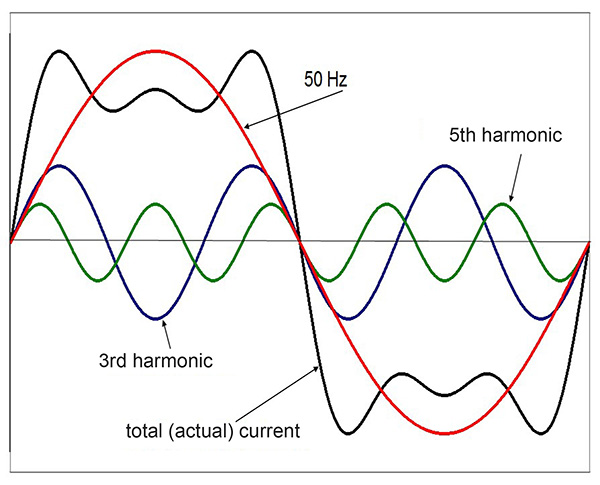
Harmonics in an electrical system can cause significant problems, including overheating, equipment malfunction, reduced efficiency, and power quality degradation. Effective harmonic mitigation strategies, such as filtering, proper system design, and equipment upgrades, are required for maintaining a stable and reliable power distribution network.
Overheating of Electrical Equipment
- Transformers: Harmonics increase the eddy current and hysteresis losses in transformer cores, leading to excessive heating. The harmonic currents also result in additional copper losses in the windings. Overheating can reduce the life expectancy of the transformer insulation, leading to potential failures.
- Cables and Conductors: Harmonic currents cause increased losses in cables and conductors, leading to overheating. Higher frequencies from harmonics lead to additional skin effect and proximity effect losses, further increasing conductor temperature. This may require de-rating of cables to handle the excess heat.
- Motors: Harmonics can cause additional core losses, torque pulsations, and heating in induction motors, affecting their performance and efficiency. Harmonic currents induce negative sequence components, causing reverse torques, which may lead to vibrations and mechanical stress.
- Generators: Similar to motors, generators experience increased core and copper losses, which result in overheating. High harmonic content can also affect generator voltage regulation and cause vibrations due to the torque pulsations from harmonic frequencies.
- Capacitors: Capacitors used for power factor correction are particularly sensitive to harmonics. Harmonic currents can cause resonances that significantly increase the current through capacitors, leading to overheating, insulation failure, or capacitor damage.
Degradation of Power Quality
- Voltage Distortion: Harmonic currents flowing through the system impedance cause voltage drops that distort the supply voltage waveform. Voltage distortion affects sensitive equipment and can lead to malfunctions.
- Flicker in Electronic Displays and Lighting: Harmonics can cause flickering in electronic displays and lighting systems due to rapid voltage fluctuations or distortions in the power supply.
Malfunction of Sensitive Equipment
- Computers and Communication Equipment: Harmonics can cause computers, servers, and other sensitive electronic devices to malfunction, reset, or fail due to distorted voltage waveforms or electromagnetic interference (EMI).
- Circuit Breakers and Protection Devices: Harmonic currents can cause nuisance tripping of circuit breakers and protective relays due to incorrect sensing of current levels or overheating of components.
- Incorrect Metering and Measurement: Harmonics can cause false readings in power meters and measurement devices, leading to inaccurate billing and energy management errors. This is because most meters are designed to measure sinusoidal waveforms, and harmonic content can distort the true power measurement.
Resonance Issues
Harmonics can cause resonance in power systems when the inductive reactance of transformers and generators matches the capacitive reactance of power factor correction capacitors or other system components. Resonance can lead to very high harmonic currents and voltages, resulting in catastrophic failure of equipment.
Reduced System Efficiency
Harmonics increase overall system losses, leading to reduced efficiency of power distribution. Increased losses translate into higher operating costs and can necessitate the use of larger conductors, transformers, and other equipment to handle the additional heat generated by harmonics.
Interference with Communication Networks
Harmonics can create electromagnetic interference (EMI) that affects communication lines, data cables, and wireless signals. This can result in data loss, communication errors, and reduced reliability of communication networks.
Reduced Life Expectancy of Equipment
Continuous exposure to harmonics stresses electrical components and reduces their operational lifespan. Equipment such as transformers, capacitors, and motors may need to be replaced more frequently, leading to increased maintenance costs and downtime.
Mitigating Harmonics in Electrical Systems
Use of Harmonic Filters
Installing passive or active harmonic filters can help mitigate harmonic distortion by filtering out specific harmonic frequencies or compensating for harmonic currents.
Equipment De-Rating
De-rating transformers, cables, and motors ensures they operate below their full capacity to account for additional heating caused by harmonics.
Proper Design of Power Factor Correction Systems
Using detuned filters or harmonic-rated capacitors prevents resonance conditions and reduces the risk of overloading capacitors.
Installation of Isolation Transformers
Isolation transformers can help prevent the transfer of harmonics between different parts of an electrical network, improving overall power quality.
Upgrading to Harmonic Tolerant Equipment
Utilizing harmonic-tolerant or low-THD equipment (such as low-THD variable frequency drives) helps reduce the generation of harmonics in the system.
THD Limit at the Output of the Generator
The 5% THD limit is specified in AS 60034.22:2010, section 7.5, for generators when tested on open-circuit and at rated speed and voltage. Excessive harmonics can lead to problems such as overheating, equipment malfunction, and decreased efficiency in electrical systems.
Total Harmonic Distortion (THD)
Total Harmonic Distortion (THD) is a measure of the distortion of a voltage or current waveform caused by harmonics. Harmonics are voltage or current components at multiples of the fundamental frequency (e.g., 50 Hz or 60 Hz). THD is expressed as a percentage of the fundamental component and is given by:
$$ \text{THD} = \sqrt{\frac{V_2^2 + V_3^2 + V_4^2 + \ldots}{V_1^2}} \times 100 $$
where \( V_1 \) is the RMS value of the fundamental component, and \( V_2 \), \( V_3 \), … are the RMS values of the harmonic components.
Parallel Resonance
The power-factor-correction capacitors cause a parallel resonance between the capacitors and the system source inductance. In fact, parallel resonance occurs when the system inductive reactance and capacitance of the capacitor bank are equal at a certain frequency. If this frequency is close to one generated by a nonlinear load, the so-called characteristic harmonic, then harmonic current will excite the ‘tank’ circuit. Amplified harmonic current results in voltage and current distortion. Serious damages can be caused by parallel resonance.

Understanding Parallel Resonance
Parallel resonance occurs in a power system when the inductive reactance of the system’s source (such as transformers, inductors, and cables) equals the capacitive reactance of a capacitor bank at a particular frequency. This resonant frequency is given by:
$$f_r = \frac{1}{2 \pi \sqrt{L C}}$$
where \( f_r \) is the resonant frequency, \( L \) is the inductance of the system, and \( C \) is the capacitance of the capacitor bank.
Role of Power-Factor-Correction Capacitors
Power-factor-correction capacitors are commonly used to improve the power factor of an electrical system by compensating for reactive power (kVAR) drawn by inductive loads such as motors and transformers. However, these capacitors can form a parallel resonant circuit with the source inductance, potentially causing resonance at certain harmonic frequencies.
Interaction with Harmonics
Harmonics are generated by non-linear loads, such as variable frequency drives (VFDs), rectifiers, and electronic equipment, which draw non-sinusoidal currents from the supply. These harmonics have frequencies that are integer multiples of the fundamental frequency (e.g., 50 Hz or 60 Hz).
When the resonant frequency of the parallel LC circuit formed by the system inductance and power-factor-correction capacitors is close to a characteristic harmonic frequency generated by these non-linear loads, the harmonic currents can excite the parallel resonant circuit.
Effects of Parallel Resonance
Amplified Harmonic Currents
At the resonant frequency, the impedance of the parallel LC circuit becomes very high, resulting in amplification of harmonic currents. This is known as a “tank circuit” effect.
Voltage and Current Distortion
The amplified harmonic currents cause significant distortion in both the current and voltage waveforms. This leads to increased Total Harmonic Distortion (THD) in the system, negatively impacting power quality.
Overheating of Equipment
Amplified harmonics cause overheating in transformers, cables, motors, and capacitors, leading to potential insulation failure, reduced equipment life, and possible fire hazards.
Capacitor Damage
Capacitors are particularly vulnerable to damage due to overvoltage and overcurrent conditions caused by resonance. This can result in capacitor overheating, dielectric breakdown, or even explosions.
Protection Device Malfunction
Protective devices such as circuit breakers and fuses can trip unnecessarily due to excessive harmonic currents, leading to unreliable operation and possible downtime.
Communication Interference
High levels of harmonics can lead to electromagnetic interference (EMI), causing malfunctions in communication and control equipment.
Mitigating Parallel Resonance
Detuned Filters
Install detuned reactors or harmonic filters in series with power-factor-correction capacitors to shift the resonant frequency away from characteristic harmonic frequencies. Detuned filters are designed to block specific harmonic frequencies while allowing fundamental frequency currents to pass.
Proper Capacitor Sizing
Carefully select capacitor banks with appropriate ratings to avoid resonating at harmonic frequencies commonly present in the system.
Harmonic Analysis and System Study
Perform a harmonic analysis and resonance study during the design phase to identify potential resonant frequencies and avoid installing equipment that could cause resonance.
Active Harmonic Filters
Utilize active harmonic filters that dynamically compensate for harmonics generated by non-linear loads, thereby preventing harmonic currents from exciting the resonant circuit.
Isolation Transformers
Using isolation transformers or harmonic mitigating transformers can help block certain harmonic frequencies and prevent resonance conditions.
Monitoring and Protection
Continuous monitoring of harmonics and system impedance can help detect resonance conditions before they cause significant problems. Protection systems should be designed to detect overvoltage or overcurrent conditions due to harmonic amplification and disconnect the affected equipment to prevent damage.
Types of Capacitor Banks
Fixed Capacitor Banks
These are connected permanently to the network and provide constant reactive power compensation. They are suitable for loads that are relatively stable and do not vary significantly.
Automatic Switched Capacitor Banks
Equipped with automatic switching controls, these banks adjust the reactive power compensation according to the load conditions, which is more efficient for networks with varying loads.
Detuned and Tuned Capacitor Banks
For networks with significant harmonic content, detuned or tuned capacitor banks are used to prevent resonance and filter specific harmonic frequencies. Detuned filters are designed to operate below the harmonic frequencies to avoid resonance, while tuned filters target specific harmonics for mitigation.
Optimal Connection Point of the Capacitor Bank to the Network
When installing capacitor banks for power factor correction in an electrical network, determining the connection point affects the network’s harmonic resonance, voltage regulation, and overall power quality. A harmonic distribution study and load analysis are required to determine the best location and size for capacitor bank installation.
A harmonic distribution study analyzes the existing harmonic levels in the network, identifies the sources of harmonics (typically non-linear loads like variable frequency drives, rectifiers, etc.), and determines the harmonic profile across different points in the network. The study helps in locating the points in the network where the harmonic distortion is minimal or manageable. Installing capacitor banks at a point with high harmonic levels could lead to issues like parallel resonance, where the capacitance of the capacitor bank resonates with the system inductance, amplifying harmonics and causing severe power quality issues.
The study identifies characteristic harmonic frequencies and the potential for resonance at these frequencies, allowing for proper selection of detuned or tuned harmonic filters if required.
Selection of Connection Point
- Busbar Location: Capacitor banks are commonly connected at major busbars within the electrical distribution network where a large concentration of inductive loads is present, such as at the main switchboard, substation, or distribution panel.
- Proximity to Harmonic Sources: Avoid placing capacitor banks near non-linear loads that generate significant harmonics. Instead, they should be placed closer to the source of power (e.g., the main distribution board) where the harmonic levels are lower, and the power factor correction will be more stable.
- Voltage Regulation: Capacitor banks can help improve voltage regulation. The optimal location is usually at points where voltage drop is significant or where the voltage needs to be stabilized for sensitive equipment.
- Avoid Resonance Points: The connection point should be chosen to avoid creating a resonant condition with the natural frequency of the network, which could amplify harmonic currents and cause overvoltage conditions.
Sizing and Design of Capacitor Banks
The average reactive power demand of the plant (measured in kVAR) must be determined to size the capacitor bank correctly. This involves analyzing the plant’s historical load data to understand its typical power factor, load profile, and reactive power requirements.
Capacitor banks are often designed with multiple steps or stages to allow for dynamic adjustment according to varying loads and power factor requirements. This modular approach helps in optimizing power factor correction without overcompensation, which can lead to overvoltage issues.
Formula for Capacitor Sizing (kVAR)
To calculate the required capacitor size in kilovolt-amperes reactive (kVAR) for power factor correction, you can use the following formula:
$$\text{Required kVAR} = P \times \left( \tan(\cos^{-1}(\text{PF}_{\text{initial}})) – \tan(\cos^{-1}(\text{PF}_{\text{desired}})) \right)$$
where:
- P = Active Power (in kW),
- PFinitial = Initial or existing power factor of the system (before correction),
- PFdesired = Desired power factor after correction.
Safety and Protection Considerations
Capacitor banks should be equipped with overvoltage protection devices such as surge arresters to protect against potential voltage surges.
Installation and Maintenance
Ensure there is adequate space, cooling, and accessibility for maintenance of capacitor banks. Overheating and poor ventilation can reduce the efficiency and lifespan of capacitors.
Load Flow Calculation Using Double Current Injection Method
The Double Current Injection Method is a power flow solution used by some software, such as SKM Power Tools, to calculate the load flow in an electrical network. In this method, the software assumes no losses and calculates the current consumptions. Losses are then calculated based on the current in each circuit. Voltage drops are determined based on these losses, resulting in new voltages on the consumer sides. These new voltages are used to calculate new currents, which lead to new losses, voltage drops, and voltages on the consumer sides. This iterative process continues until the calculated values converge to a precise result.
Another method for power flow calculation is the Newton-Raphson Method. This method solves the load flow based on non-linear load flow equations. For each bus, there are two non-linear simultaneous equations. The real and reactive powers depend on the product of the sum of the voltage connected between two buses and the admittance between the buses. The Newton-Raphson method can converge relatively fast for systems with loops, multi-voltage levels, and numerous power generators.
Standard Voltage Levels in Australia
Under normal supply conditions, it is recommended that the voltage at the point of supply should not differ from the normal voltage of the system by more than +10% -6% for the utilization voltage range (AS 60038, 2000).
In addition to the voltage variations at the point of supply, voltage drop may occur within the consumer’s installations. For low voltage installations, this voltage drop is limited to 5% in accordance with AS/NZS 3000. Therefore, the utilization voltage range is +10% -11% at the consumer point.
AS 60038 defines connecting supply voltage range as listed below.
AC HV Power Supply
| Description | Value |
|---|---|
| System Nominal Voltage | 6600 V AC |
| Neutral Earthing | High Resistance Earthed |
| Switchboard Steady State Voltage | 6600 V AC ± 5% |
| Switchboard Transient Voltage | 6600 V AC ± 10% |
| Load Terminal Transient Voltage | 6600 V AC +10/-20% |
| System Nominal Frequency | 50 Hz |
| Steady State Frequency | 50 Hz ± 2% |
| Transient Frequency | 50 Hz ± 5% |
AC LV Power Supply
| Description | Value |
|---|---|
| System Nominal Voltage | 400 V AC |
| Neutral Earthing | Solidly Earthed |
| Switchboard Steady State Voltage | 400 V AC ± 5% |
| Switchboard Transient Voltage | 400 V AC ± 10% |
| Load Terminal Transient Voltage | 400 V AC +10/-20% |
| System Nominal Frequency | 50 Hz |
| Steady State Frequency | 50 Hz ± 2% |
| Transient Frequency | 50 Hz ± 5% |
AC Critical Power Supply (UPS)
| Description | Value |
|---|---|
| System Nominal Voltage | 400/230 V AC |
| Neutral Earthing | Solidly Earthed |
| Steady State Voltage | 400/230 V AC ± 1% |
| Transient Voltage | 400/230 V AC ± 5% |
| Steady State Frequency | 50 Hz ± 1% |
| Frequency Variations | 0.2 Hz/second |
DC Critical Power Supply (UPS)
| Description | Value |
|---|---|
| System Nominal Voltage | 24 V DC |
| Negative Earthing | Solidly Earthed |
| Steady State Voltage | 24 V DC ± 3% |
Distribution Voltages
| Description | Value |
|---|---|
| System Nominal Voltage | 11000 V AC |
| Neutral Earthing | Solidly Earthed |
| Switchboard Steady State Voltage | 11000 V AC ± 5% |
| Switchboard Transient Voltage | 11000 V AC ± 10% |
| Load Terminal Transient Voltage | 11000 V AC +10/-20% |
| System Nominal Frequency | 50 Hz |
| Steady State Frequency | 50 Hz ± 2% |
| Transient Frequency | 50 Hz ± 5% |