
Short-Circuit Faults
The Short-Circuit Worst-Case Scenario
In electrical power systems, the three-phase short circuit is generally considered the worst-case scenario in terms of fault currents and system stability. This is because a three-phase fault typically results in the highest fault current levels and has the most severe impact on the stability and protection of the system.
While a three-phase short circuit is generally considered the worst-case scenario, there are situations in networks with specific transformer connections and earthing methods (e.g., star point earthed with low resistance) where single-phase or two-phase fault currents could be higher. Thus, it is essential to analyse the specific network configuration, transformer connections, earthing type, and fault impedance to accurately determine which short circuit scenario represents the worst case.
Three-Phase Short Circuit
In a balanced three-phase system, a three-phase short circuit occurs when all three phases are shorted together, either directly or through a low impedance. This type of fault results in the maximum fault current because all three phases contribute to the fault.
It is usually considered the worst-case scenario because it leads to the highest thermal and mechanical stress on equipment, maximum power loss, and the greatest potential for system instability.
Protection systems are generally designed to handle three-phase faults as they represent the maximum fault level.
Single-Phase-to-Ground Fault (L-G)
This occurs when one phase is shorted to ground. The fault current in this scenario can be lower than in a three-phase fault, especially in systems with high impedance grounding. However, in systems with solidly grounded or low-resistance-grounded neutrals, the fault current can still be significant.
Two-Phase Short Circuit (L-L)
This occurs when two phases are shorted together without involving the ground. The fault current is typically less than that of a three-phase fault, but still significant.
Two-Phase-to-Ground Fault (L-L-G)
This involves two phases shorted together and to the ground. The fault current in this scenario can vary but is generally lower than in a three-phase fault.
Impact of Transformer Connections and Earthing
In networks with Delta/Wye (D/Y) transformer connections, the earthing configuration of the transformer’s star point determines the fault current levels. If the star point is solidly earthed or earthed through a low-resistance grounding, the impedance to ground is low. This can lead to higher single-phase or two-phase fault currents compared to systems with higher impedance grounding.
In such configurations, a single-phase-to-ground (L-G) fault or two-phase-to-ground (L-L-G) fault could potentially result in a higher fault current than a three-phase fault, depending on the zero-sequence impedance and the distribution of fault currents in the network.
Sequence Impedances (Z1, Z2, Z0)
For the common case where \( Z_1 = Z_2 \), the highest line fault current occurs for the three-phase short circuit when \( Z_0 \) is larger than \( Z_2 \).
However, for faults near transformers, particularly with delta or zigzag winding connections on the low-voltage side, \( Z_0 \) may be smaller than \( Z_2 \). In this case, the highest line fault current occurs for the line-to-earth short (when \( Z_0 \) is very small), while the highest earth fault current occurs for the line-to-line-to-earth short circuit.
Power Factor of the System During the Short Circuit
The power factor during a short circuit is significantly affected by the nature of the fault. During a short circuit, the power factor is typically very low (about 0.15) due to the high apparent power and minimal real power.
The breaker’s protection settings should be evaluated to ensure they operate correctly under these low power factor conditions.
Definitions of Sub-Transient Impedance of Motors and Generators
Circuit breakers, relays, and other protective devices are rated to withstand the highest expected short-circuit current, which occurs during the sub-transient period. This period defines the prospective short-circuit current used for equipment testing.
Fault currents are composed of a symmetrical AC current and most likely, an aperiodic current component known as the DC decay component. Local generators and motors contribute to the short circuit current. This contribution is cause of the DC decay component.
For simplicity in the ANSI standards, the short circuit current is modelled as a constant voltage source behind a time-varying impedance. At the initial instant of the fault this impedance is known as the “sub-transient impedance”. But this changes to “transient impedance” two or three cycles into the fault. The steady-state current is modelled as the machine’s synchronous impedance.
The sub-transient impedance of motors or generators determines the initial short-circuit current during a fault. It is the impedance that appears during the very first few milliseconds of a fault, before the transient and steady-state conditions are reached.
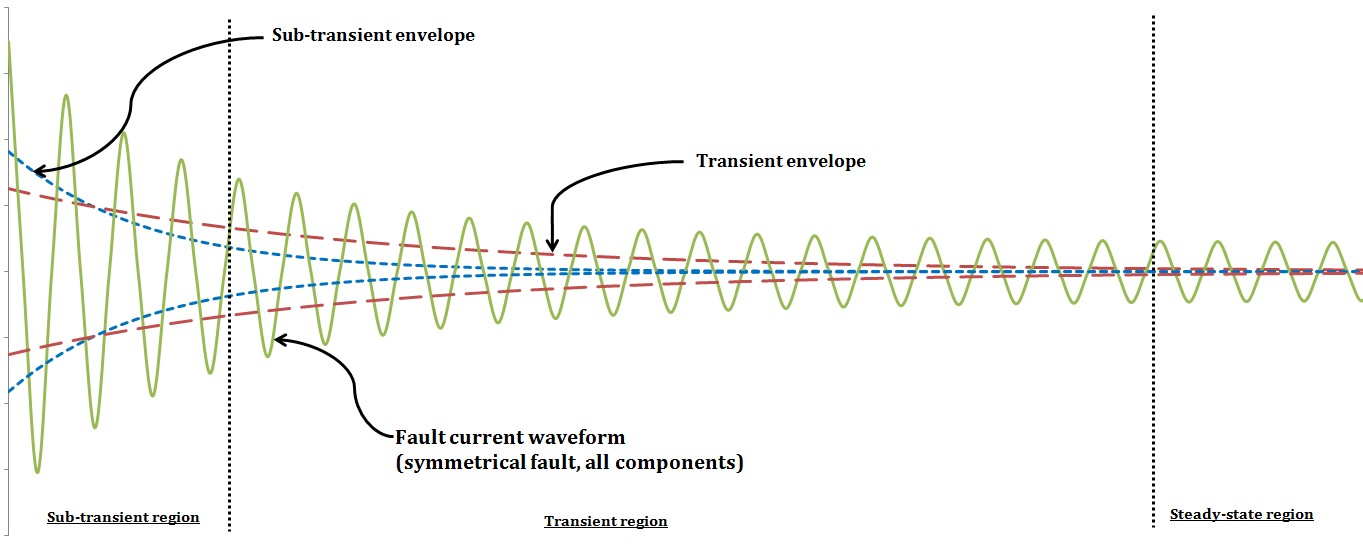
Large generators and motors are designed with specific sub-transient and transient reactance values to limit the initial fault current and protect the machine from damage during faults.
Sub-Transient Impedance (X”)
This is the impedance that is effective during the first few cycles (typically the first 0.5–2 cycles) of the fault. During this period, the fault current is at its maximum, driven by the lowest effective impedance. The sub-transient impedance is the smallest impedance value, resulting in the highest short-circuit current.
This represents the initial response of the motor or generator’s magnetic field and armature winding to the fault. In large machines, the sub-transient reactance is primarily inductive, as the resistance is negligible.
Note: The slower motor has a smaller momentary short circuit current contribution than the faster motor attached to the bus.
Transient Impedance (X′)
After the sub-transient period, the impedance rises slightly, and the fault current decays to a lower value. This is due to the time-varying inductive and reactive components of the machine’s windings stabilizing. The transient period lasts for a few cycles (around 2-3 cycles) as the energy stored in the inductance decays.
Synchronous Impedance (Xd)
This is the impedance after the transient period has decayed and represents the impedance during normal and stable operating conditions. In this period, the machine’s internal reactance has stabilized, and the current reaches a steady value, which is significantly lower than the sub-transient and transient currents.
At steady-state, the generator or motor no longer contributes significantly to the short-circuit current, as the DC decay component has diminished, and the system operates with its nominal synchronous impedance.
Far-from-Generator Short Circuit Definition
Remote Short-Circuit Current Contribution
The short circuit occurs far enough from the generator that the symmetrical AC component of the fault current remains steady and is less influenced by the generator.
A generator’s short-circuit contribution is considered remote when the reactance external to the generator (typically the impedance of transformers, transmission lines, etc.) is 1.5 times or greater than the generator’s sub-transient reactance. In such cases, the generator’s contribution to the short-circuit current diminishes because the external system impedance limits the fault current.
Near-to-Generator Short Circuit
The short circuit occurs close to the generator, leading to significant contributions from the generator and possibly from motors, resulting in high initial fault currents.
By definition, the near-to-generator short-circuit is a fault where at least one synchronous machine contributes a prospective initial symmetrical short-circuit current that is more than twice the generator’s rated current. Or, it defines a fault where synchronous and asynchronous motors contribute more than 5% of the initial symmetrical short-circuit current (I”k) if no motors are present.
This type of short circuit has a higher initial fault current due to the generator’s and possibly motor’s contributions. The system needs to handle higher fault currents, and the initial impact can be significant.
Impact of X/R Ratio of a Utility Grid on Short Circuit Behaviour in a Power System
The X/R ratio represents the ratio of the system’s reactance (X) to its resistance (R). A high X/R ratio indicates that the system is predominantly inductive (common in transmission systems).
The X/R ratio is determined by the impedance characteristics of the supply network, which is under the control of the main supply authority. Requesting this data ensures coordination between the consumer’s system and the utility grid. This is especially important when:
- New equipment is installed (e.g., transformers, generators) that interact with the grid.
- The consumer is connecting a large facility, such as a substation or industrial plant, to the utility grid.
By knowing the X/R ratio, consumers can avoid issues like incorrect fault current calculations, protection failures, and overstressed equipment due to improper system coordination with the supply network.
Effect of X/R Ratio on Fault Currents
When a fault occurs (such as a line-to-ground or phase-to-phase short circuit), the fault current has both AC and DC components:
- AC component: Driven by the system’s impedance.
- DC component (DC offset): Caused by the sudden interruption of current flow, which causes a transient response.
The X/R ratio determines the rate of decay of the DC offset. A high X/R ratio corresponds to a longer time constant (τ = L/R), where:
$$ \tau = \frac{L}{R} = \frac{X}{\omega R} $$
This means that in systems with a high X/R ratio, the DC offset in fault currents will decay more slowly. The slow decay of the DC offset results in larger peak currents, which need to be accounted for in protection systems.
Ensuring Compliance with Standards
Electrical systems must comply with international and local standards (such as IEC 60909 or IEEE 141), which specify how fault currents should be calculated, including the impact of the X/R ratio on fault asymmetry.
Impact on Circuit Breakers
Circuit breakers are rated based on their ability to handle the peak short-circuit current. A higher X/R ratio means that the DC offset lasts longer, resulting in a higher peak current for a given fault. This can impact the interrupting duty of the circuit breaker, requiring it to be capable of clearing higher fault levels.
Circuit breakers are rated not just for the steady-state AC fault current, but also for the peak asymmetrical fault current, which includes the DC offset component. The X/R ratio provided by the main supply authority is used to calculate this peak fault current:
$$ I_{\text{peak}} = I_{\text{sym}} \times \left(1 + \text{DC component factor}\right) $$
Where the DC component factor depends on the X/R ratio. The higher the X/R ratio, the greater the DC offset, which increases the peak current.
Transformer and Equipment Design
When designing transformers, generators, and other electrical equipment, manufacturers need to know the fault level and the X/R ratio of the supply system. This information is required for:
- Thermal design: Equipment must withstand the heating effects of fault currents, which are higher if the X/R ratio is high.
- Mechanical stress: Lasting higher peak currents (due to high X/R ratios) impose greater mechanical stresses on conductors and windings within transformers and other equipment, affecting their structural integrity and lifespan.
- Dielectric stress: A higher X/R ratio can increase the voltage transients during faults, which might lead to insulation failures in transformers and switchgear.
The Range of Magnitude of the Generator Short Circuit DC Component
The magnitude of the generator short-circuit DC component is directly related to the moment at which the fault (short circuit) occurs during the AC cycle. The DC component arises from the transient response of the system, which is driven by the sudden change in current caused by the fault.
The size of the DC component depends on the exact timing of the fault in the AC cycle. The DC component can range from zero (if the fault occurs at peak voltage) to a value that results in a peak short-circuit current nearly twice the symmetrical current.
If the short circuit occurs at the point in the cycle where the voltage is at its peak, the DC component will be zero, and the short-circuit current will be purely symmetrical AC current.
If the short circuit occurs at the point in the cycle where the voltage and current are at zero, the DC component will be at its maximum.
For the purpose of selecting the interrupting rating of circuit breakers, the assumption that the DC offset will be at maximum is a safe and conservative assumption ( Isc-sym × 2 ).
Percentage Impedance of Electrical Equipment
Manufacturers give impedance of equipment in percent on its own base. The percent value is the per unit value multiplied by 100 (\( Z\% = Z_{pu} \times 100 \)). The expression “own base” means that the base voltage is the rated voltage of the equipment, and the base power is the rated apparent power (in VA) of the equipment. The base current and the base impedance are calculated from the base voltage and the base VA.
$$ \text{MVA}_{\text{base}} = \sqrt{3} \, V_{\text{base}} \, I_{\text{base}} $$
$$ I_{\text{base}} = \frac{\text{MVA}_{\text{base}}}{\sqrt{3} \, V_{\text{base}}} $$
$$ Z_{\text{base}} = \frac{V_{\text{base}}}{I_{\text{base}}} = \frac{\sqrt{3} \, V_{\text{base}}^2}{\text{MVA}_{\text{base}}} $$
$$ Z_{pu} = \frac{Z}{Z_{\text{base}}} $$
$$ I_{\text{SC}} = \frac{V_{\text{base}}}{Z} = \frac{V_{\text{base}}}{Z_{\text{base}}} \times \frac{Z_{\text{base}}}{Z} = \frac{I_{\text{base}}}{Z_{pu}} $$
Percentage Impedance of a Transformer
In order to determine the percentage impedance of a transformer, the secondary should be short-circuited. Then increase the input voltage in the primary until the current in the primary reaches the base current \( I_{\text{base}} \). Measure the applied voltage \( V \).
$$ Z = \frac{V}{I_{\text{base}}} \quad \Rightarrow \quad V = Z \, I_{\text{base}} = Z \, \frac{V_{\text{base}}}{Z_{\text{base}}} $$
$$ \frac{V}{V_{\text{base}}} = \frac{Z}{Z_{\text{base}}} = Z_{pu} \quad \Rightarrow \quad Z\% = 100 \, Z_{pu} = 100 \, \frac{V}{V_{\text{base}}} $$
Therefore, the percentage impedance can be determined from the measured primary voltage.
Sequence Impedances (Z1, Z2, and Z0)
In power system analysis, sequence impedances (positive, negative, and zero sequence) are used to represent the behaviour of electrical equipment during unbalanced conditions such as faults. These impedances are used in symmetrical component analysis, which simplifies the study of unbalanced power systems by breaking down the complex, three-phase system into simpler, single-phase systems.
Positive Sequence Impedance (Z1)
Positive sequence impedance is the impedance seen by balanced, three-phase currents under normal operating conditions. When all phases of the system are balanced and symmetrical, the system operates in the positive sequence. The positive sequence currents generate a rotating magnetic field in synchronous machines, and the corresponding impedance is called the positive sequence impedance. It is mainly determined by the generator, transmission lines, transformers, and other network components under normal operation.
Negative Sequence Impedance (Z2)
Negative sequence impedance is the impedance seen by a system when it is subjected to unbalanced conditions, such as when there is a phase-to-phase fault or when unbalanced currents flow in the system. Negative sequence currents circulate in a reverse direction compared to positive sequence currents, creating a rotating magnetic field in the opposite direction. These currents do not contribute to useful power and can cause overheating and mechanical stress in rotating machines.
For synchronous machines, the negative sequence impedance is typically higher than the positive sequence impedance due to the opposing magnetic field. In a fault condition where two phases are shorted, the negative sequence current flows, and the impedance presented by the system to this current is $Z_2$.
Zero Sequence Impedance (Z0)
Zero sequence impedance is the impedance seen by zero sequence currents, which are equal in magnitude and flow in all three phases in the same direction, often occurring during ground faults. Zero sequence currents occur when there is an unbalanced fault involving the ground, such as a single line-to-ground (SLG) fault. These currents return through the ground or neutral conductor.
Zero sequence impedance depends heavily on the presence of grounded neutral connections and the configuration of the system (e.g., solidly grounded, ungrounded, or impedance grounded systems).
For transmission lines, zero sequence impedance is higher than positive sequence due to ground return paths. For transformers, the zero-sequence impedance depends on the grounding of the transformer windings.
Comparison of Sequence Impedances
| Sequence Impedance | Representation | Typical Use Cases | Behaviour in Machines |
|---|---|---|---|
| Positive (Z1) | Balanced system | Normal operation, three-phase balanced faults | Supports synchronous machine operation |
| Negative (Z2) | Unbalanced system | Phase-to-phase faults, unbalanced loads | Causes reverse rotating magnetic field |
| Zero (Z0) | Ground path | Single line-to-ground faults, neutral grounding | Depends on grounding system, involved in SLG faults |
Note: The Thevenin equivalent voltage for the positive sequence network is normally taken as the phase-to-neutral voltage at the fault location prior to the fault occurring. The Thevenin equivalent voltage for the negative and zero sequence networks is zero.
Location of the Fault in Relation to the Observation Point
The concept of negative-sequence impedance is defined as the ratio of negative-sequence voltage to negative-sequence current. This impedance behaves differently based on the location of the fault in relation to the observation point. In the case of forward faults, where the fault lies ahead of the observation point, the negative-sequence impedance will have a negative value. Conversely, for reverse faults, where the fault is behind the observation point, the negative-sequence impedance will be positive. This distinction is crucial for protective relaying systems to accurately detect and respond to faults by identifying their direction and type.
The Sequence Impedance of Transformers
The positive impedance of a transformer equals the leakage impedance. It may be obtained by the usual short circuit test. A reduced voltage is applied to one winding while the other is short-circuited. The impedance can be derived from the voltage, current, and power measurements.
Since the transformer is a static device, the leakage impedance does not change if the phase sequence is altered from RYB to RBY. Therefore, the negative sequence impedance of a transformer is the same as the positive sequence impedance.
The zero-sequence impedance of the transformer depends on the winding type (star or delta) and also on the type of earth connection.
The positive and negative sequence per-unit impedances are independent of whether the sequence currents are injected into the primary or the secondary. However, the zero-sequence impedance will have different values depending upon whether the sequence currents are injected into the primary or the secondary. Note that the zero-sequence currents cannot be injected into the delta terminals.
Zero-Sequence Impedance in Different Transformer Configurations
- Delta (Δ) Winding: For a transformer with a delta winding, zero-sequence currents cannot flow within the transformer since there is no ground connection. As a result, the zero-sequence impedance is effectively infinite. If a ground fault occurs on the secondary side of a transformer with a delta primary winding, no zero-sequence current will flow into the delta-connected side because it doesn’t provide a return path for ground current.
- Star (Y) Winding with Solidly Grounded Neutral: In a star-connected transformer with a solidly grounded neutral, the zero-sequence currents have a direct return path through the neutral. The zero-sequence impedance is primarily determined by the leakage impedance between the windings and the core, as well as the grounding connection. Typically, the zero-sequence impedance in this configuration is relatively low (similar to or slightly higher than the positive sequence impedance) because the ground provides a low impedance path.
- Star (Y) Winding with Impedance Grounding or Ungrounded Neutral: If the star winding’s neutral is grounded through an impedance or left ungrounded, the zero-sequence impedance increases. The ground fault current is limited by the impedance of the grounding device or the natural capacitance of the system. The zero-sequence impedance is higher in this case due to the restricted current path, and it depends on the impedance connected to the neutral.
- Zigzag Transformer: A zigzag transformer is specifically designed to provide a low-impedance path for zero-sequence currents. It is often used for grounding systems to allow zero-sequence currents to flow freely. Zigzag transformers have a low zero-sequence impedance and are ideal for handling ground faults.
The zero-sequence impedance of a transformer is not typically calculated in the same manner as positive or negative sequence impedances. Instead, it is often determined through testing and measurements.
Sequence Impedance Values for Electrical Equipment
Power Lines
For power lines, the positive and negative sequence impedances are equal and can be calculated as:
$$Z_1 = Z_2 = \frac{V_{LN}}{I_k}$$
where \( I_k \) is the steady-state short circuit current.
The zero-sequence impedance for power lines is typically approximated as:
$$Z_0 = 0.8 \, Z_1$$
Transformers
For transformers, the positive and negative sequence impedances are generally equal:
$$Z_1 = Z_2$$
The zero-sequence impedance \( Z_0 \) of a transformer depends on the transformer’s winding configuration (star-wye, delta, or zigzag) and the method of grounding (solid grounding, impedance grounding, or ungrounded) of the transformer’s neutral point.
Asynchronous Motors
In the case of rotating machines such as asynchronous motors, the values of positive-sequence and negative-sequence impedances can differ. However, for far-from-generator short-circuits, it is often sufficient to assume:
$$Z_1 = Z_2 = \frac{V_{LN}}{I_{LR}}$$
where \( I_{LR} \) is the locked rotor current.
The zero-sequence impedance of asynchronous motors is typically taken as:
$$Z_0 = 0 \, \text{or} \, \frac{Z_1}{2}$$
This is because the windings are often delta-connected or unearthed star-connected (as per AS 3851).
VFDs or Converters
If the VFD or converter is non-regenerative, it is usually ignored in sequence impedance calculations. If regenerative, the impedance is treated similarly to that of motors, with:
$$I_{LR} = 3 \, I_N$$
Synchronous Generators/Motors/Compensators
For synchronous machines (generators, motors, and compensators), the positive and negative sequence impedances are given by:
$$Z_1 = Z_2 = R_G + jX_d”$$
where \( X_d” \) is the direct-axis subtransient reactance, and \( R_G \) is the resistance of the generator or motor.
The zero-sequence reactance \( Z_0 \) is typically about half of the positive sequence reactance:
$$Z_0 \approx \frac{Z_1}{2}$$
In industrial power system short-circuit calculations, it is common to use reactance only (ignoring resistance), as this often results in slightly higher short-circuit current values, typically within 0–3% of the true value.
MVA Method for Short-Circuit Current Calculation
The MVA method is widely used for solving industrial power system short circuit calculations. It is essentially a modification of the Ohmic method, where the impedance of a circuit is the sum of the impedances of various components. The following calculations demonstrate the method for a three-phase fault current calculation.
$$I_{SC} = \frac{V_{base}}{Z} = \frac{\left( \frac{V_{base}}{Z_{base}} \right)}{\left( \frac{Z}{Z_{base}} \right)} = \frac{I_{base}}{Z_{pu}} \rightarrow \sqrt{3} V_{base} I_{SC} = \frac{\sqrt{3} V_{base} I_{base}}{Z_{pu}} \rightarrow MVA_{SC} = \frac{MVA_{base}}{Z_{pu}}$$
Two Pieces of Equipment in Series
Now consider two pieces of equipment (e.g., a main network and a transformer) in series contributing to the short circuit current. The short circuit current can be calculated as follows:
$$I_{SC} = \frac{V_{base}}{Z_1 + Z_2} = \frac{\left( \frac{V_{base}}{Z_{base}} \right)}{\left( \frac{Z_1}{Z_{base}} + \frac{Z_2}{Z_{base}} \right)} = \frac{I_{base}}{Z_{1pu} + Z_{2pu}} \rightarrow \frac{1}{I_{SC}} = \frac{1}{\left( \frac{I_{base}}{Z_{1pu}} \right)} + \frac{1}{\left( \frac{I_{base}}{Z_{2pu}} \right)}$$
$$\frac{1}{\sqrt{3} V_{base} I_{SC}} = \frac{1}{\left( \frac{\sqrt{3} V_{base} I_{base}}{Z_{1pu}} \right)} + \frac{1}{\left( \frac{\sqrt{3} V_{base} I_{base}}{Z_{2pu}} \right)} \rightarrow \frac{1}{MVA_{SC}} = \frac{1}{MVA_{1SC}} + \frac{1}{MVA_{2SC}}$$
Two Pieces of Equipment in Parallel
Now consider two pieces of equipment (e.g., a motor and a transformer) in parallel contributing to the short circuit current. The short circuit current is calculated as follows:
$$I_{SC} = I_{1SC} + I_{2SC} \rightarrow \sqrt{3} V_{base} I_{SC} = \sqrt{3} V_{base} I_{1SC} + \sqrt{3} V_{base} I_{2SC} \rightarrow MVA_{SC} = MVA_{1SC} + MVA_{2SC}$$
It can be easily recognized that series MVA combinations are exactly like resistances computed in parallel, and parallel MVA contributions are computed like resistances in series.
Note that in the MVA method, a common MVA base is not required, as is necessary in the per unit method. Additionally, it is not necessary to convert impedances from one voltage level to another, as required in the Ohmic method.
Using MVA Method for Each Type of Fault
Application of Symmetrical Components in Fault Analysis
In symmetrical component analysis, each type of fault involves different combinations of positive, negative, and zero sequence impedances. Below are the methods used to calculate the short circuit current for different types of faults:
Three-Phase Fault
For a balanced three-phase fault, only positive sequence currents flow, and the short-circuit MVA is calculated as:
$$ MVA_{SC} = MVA_1 $$
Single Line-to-Ground Fault
For a line-to-ground fault, all three sequence components (positive, negative, and zero) contribute to the short-circuit current. The formula is:
$$ MVA_{SC} = \frac{3}{\left( \frac{1}{MVA_1} + \frac{1}{MVA_2} + \frac{1}{MVA_0} \right)} $$
Line-to-Line Fault
In a phase-to-phase fault, positive and negative sequence currents flow. The short-circuit MVA is calculated using the following formula:
$$ MVA_{SC} = \frac{\sqrt{3} MVA_1}{2} $$
Line-to-Line-to-Ground Fault
For a line-to-line-to-ground fault, all three sequence components contribute. The short-circuit MVA is given by:
$$ MVA_{SC} = \frac{3 MVA_1 \times MVA_0}{MVA_1 + MVA_2 + MVA_0} $$
Additional Considerations
Note 1: Motors that cannot be operated simultaneously, such as interlocked or standby motors, do not need to be represented in the short-circuit calculation.
Note 2: For near-to-generator three-phase short circuits, the magnitude of the steady-state short-circuit current \( I_k \) depends on the automatic excitation regulator, system saturation, and switching conditions. Its calculation is generally less accurate than that of the initial symmetrical short-circuit current \( I^{\prime\prime}_k \).
Note 3: The contribution of asynchronous motors is typically less than that of synchronous motors, which in turn contribute less than generators.
Note 4: In cases where \( Z_1 = Z_2 \), the highest line fault current will occur for a three-phase short-circuit when \( Z_0 \) is larger than \( Z_2 \). However, for faults near transformers, particularly with delta or zigzag winding connections on the low voltage side, \( Z_0 \) may be smaller than \( Z_2 \). In that case the highest line fault current will occur for the line-to-earth short (\( Z_0 \) is very small), while the highest earth fault current will occur for the line-to-line-to-earth short circuit.
Temperature Adjustment of Circuit Resistance
To calculate the minimum short-circuit current, the resistance \( R_L \) of circuits (such as overhead lines and cables) must be adjusted for elevated temperatures. This adjustment is made using the equation below:
$$ R_L = 1.5 R_{L20} $$
Where \( R_{L20} \) is the resistance at a reference temperature of 20ºC.
Typical Per-unit Values of Reactance for Generators (40-2000 kW)
| Reactance | Description | Symbol | Range (pu) | Period |
|---|---|---|---|---|
| Sub-transient reactance | Determines the maximum instantaneous current and the current at the time the circuit breaker usually opens | \( X^{\prime\prime}_d \) | 0.09 – 0.17 | 0-6 Cycles |
| Transient Reactance | Determines current at short time delay of circuit breakers | \( X^{\prime}_d \) | 0.13 – 0.20 | 6 cycles to 5 sec. |
| Synchronous reactance | Determines steady state current without excitation support (PMG) | \( X_d \) | 1.7 – 3.3 | After 5 sec. |
| Zero sequence reactance | A factor in L-N short circuit current | \( X_0 \) | 0.06 – 0.09 | – |
| Negative sequence reactance | A factor in single-phase short circuit current | \( X_2 \) | 0.10 – 0.22 | – |
The sub-transient reactance of a generator set is used to calculate the maximum available short-circuit current for selecting circuit breakers with adequate interrupting ratings. Since nearly all of the generator impedances are reactance, the addition of the DC component for the first few cycles may almost double the symmetrical value of current.
Tolerance in Reactance Measurements
Reactance values, including sub-transient reactance, are typically expressed with a tolerance of ±10%. To determine the maximum current, the worst-case tolerance of -10% should be used.
Saturated vs. Unsaturated Reactance in Generators
Generators operate differently under fault conditions due to magnetic saturation. The unsaturated sub-transient reactance (\( X^{\prime\prime}_{d,\text{unsat}} \)) represents the opposition to current flow in normal conditions when the magnetic core can still store additional magnetic flux. However, under fault conditions, high currents cause the generator’s core to reach magnetic saturation, reducing its ability to oppose the current. In this state, the saturated sub-transient reactance (\( X^{\prime\prime}_{d,\text{sat}} \)) is the relevant parameter.
When a generator’s core becomes saturated, further increases in current do not produce proportional increases in magnetic flux. This results in a lower effective reactance, as the generator can no longer generate the same level of opposition to changing currents. The saturated reactance reflects this decreased opposition, which is critical for fault current analysis.
It is common practice to approximate the saturated reactance as 85% of the unsaturated reactance when the saturated value is not provided. The 85% approximation is based on industry experience and typical generator design behaviour during faults.
The saturated reactance is necessary for accurate short-circuit current calculations, as using the unsaturated reactance could lead to underestimating the actual fault current, potentially resulting in improperly sized protective equipment.
The saturated impedance of a generator results in a higher short-circuit current compared to the unsaturated impedance. Since short-circuit current is inversely proportional to reactance, a lower reactance (as in the saturated case) leads to a higher short-circuit current.
$$ I_{\text{sc}} = \frac{I_{\text{base}}}{X^{\prime\prime}_d} $$
Where:
- \( I_{\text{sc}} \) is the short-circuit current,
- \( I_{\text{base}} \) is the base current of the system, and
- \( X^{\prime\prime}_d \) is the generator’s sub-transient reactance (either saturated or unsaturated).
Generator Reactance Conversion
Typically, generator reactance is published in per-unit values based on a specified base alternator rating. Where the generator set rating differs from the alternator base rating, it is necessary to convert the per-unit values from the alternator base rating to the generator set rating.
$$ X^{\prime\prime}_{d2} = X^{\prime\prime}_{d1} \left( \frac{kV_{base1}}{kV_{base2}} \right)^2 \left( \frac{kVA_{base2}}{kVA_{base1}} \right) $$
Where:
- \( X^{\prime\prime}_{d2} \) = Sub-transient reactance on the generator set’s base,
- \( X^{\prime\prime}_{d1} \) = Sub-transient reactance on the alternator’s base (as published by the manufacturer),
- \( kV_{base1} \) = Base voltage of the alternator,
- \( kV_{base2} \) = Base voltage of the generator set,
- \( kVA_{base1} \) = Base kVA of the alternator,
- \( kVA_{base2} \) = Base kVA of the generator set.
This conversion is important because the per-unit system is normalized, and failing to adjust for different base values would lead to inaccurate short-circuit current calculations.
Generator-Transformer Block Without Circuit Breaker
In certain configurations, it is acceptable not to include a circuit breaker between the power generator and the low-voltage (LV) or high-voltage (HV) transformer. This is often the case when the generator and transformer form a dedicated unit known as a generator-transformer block or unit. In such setups, the generator’s output is directly connected to the transformer, and the main circuit breaker is placed on the transformer’s high-voltage side. This configuration is particularly common in power generation plants, where efficiency and cost optimization are key considerations.
One of the main advantages of omitting the circuit breaker between the generator and transformer is the reduction of short-circuit current stress on the generator. The transformer’s leakage reactance, which is inherently present in its windings, acts as impedance that limits the fault current contribution from the generator during a short-circuit event. This reduces the fault current levels seen by the generator, which can protect its windings from excessive mechanical and thermal stresses caused by high fault currents. As a result, the generator-transformer unit operates in a more stable and protected manner during fault conditions.
Another benefit of placing the circuit breaker on the HV side of the transformer is related to system economics and reliability. High-voltage circuit breakers are generally more efficient and less prone to frequent operation than low-voltage breakers in large power systems. Additionally, not having a circuit breaker between the generator and transformer reduces the complexity of the protection scheme. It also lowers maintenance requirements and eliminates the potential for unnecessary disconnections between the generator and transformer during normal operation.
However, not installing a circuit breaker between the generator and transformer comes with certain trade-offs. For example, protection coordination becomes critical, and alternative means of isolating the generator for maintenance or faults must be considered. Furthermore, in some designs, other protective devices, such as fuses, load-break switches, or disconnectors, may be incorporated to ensure proper isolation without the need for a circuit breaker. In scenarios where flexible operation or quick disconnection of the generator is required, omitting the circuit breaker might not be suitable, and additional considerations for operational safety and protection must be addressed.
In conclusion, while omitting a circuit breaker between the generator and transformer is acceptable in specific generator-transformer unit configurations, it is essential to ensure that the protection scheme is well-coordinated, with the main circuit breaker on the transformer’s high-voltage side and appropriate measures in place to handle fault conditions and isolation requirements.